


Word Wanderer - win real cash
4.8300.00 Reviews
App Specs
- Version
- 1.4
- Updated On
- License
- Free
- Downloads
- 50,000+
- Developer
- hindustanfood
- Categories
- Word
- Platform
- Android
Screenshots



 Analysis by AppCompare
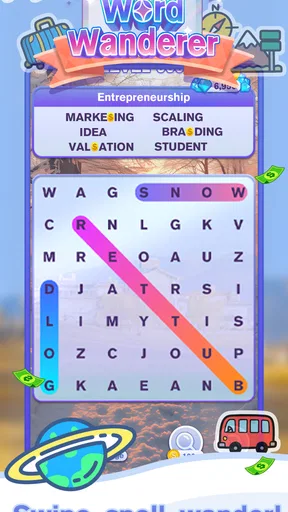
I went into Word Wanderer expecting a light word game for short breaks, but its promise of turning completed word sessions into diamonds and possible PayPal cash-outs gives every swipe a second purpose. That combination makes the first few plays more attention-grabbing than a standard anagram or word-search game. You are not only trying to find words; you are also watching the reward layer and wondering whether it can keep your interest after the initial novelty wears off.
This is a free word game from hindustanfood, rated for Everyone and available for devices running Android 9 or later. Its store presence is already fairly visible, with more than 50 thousand installs, a 4.8 average from around 2.8 thousand ratings, and 299 written reviews. Those figures suggest that the basic idea connects with players, although they do not tell me whether the cash-out experience will feel equally satisfying for every person.
How Word Wanderer feels beyond the first few sessions
I find the lasting appeal of Word Wanderer depends less on the novelty of its rewards and more on whether its word puzzles remain satisfying once the routine is familiar. A useful way to judge that is to notice whether I choose a session for the letter challenge itself, then keep the reward system in perspective. That makes it easier to decide what kind of fairness and spending expectations are reasonable.
The first-week appeal is easy to understand
The strongest part of the experience is the low barrier to entry. Word games work well when I can open one without remembering a complicated control scheme, and the swipe-based approach suits that kind of casual use. I can imagine playing while waiting for a bus, taking a short break from work, or winding down without committing to a long level. The familiar act of connecting letters is immediately readable, while the diamond reward gives ordinary word finding a clearer sense of progress.
That reward loop is also the first thing I would treat carefully. The phrase “win real cash” naturally raises expectations, but earning in-game diamonds and successfully receiving money are not necessarily the same experience. I would approach the game as a word puzzle first and a possible reward opportunity second. That mindset makes the opening sessions more enjoyable because I am not measuring every move against an assumed income.
During the first week, the game’s appeal comes from small moments of momentum. Finding a short word can lead me toward a longer one, and a quick session can become several rounds simply because I am close to another reward milestone. This is a familiar psychological trick in casual games, but here it fits the theme better than a generic points counter would. Diamonds feel more purposeful because they are connected to the cash-out promise.
There is also a useful social and personal angle, even without needing a competitive mindset. I can use a few rounds as a mental warm-up before studying, or as a way to switch attention after a screen-heavy task. Players who enjoy spelling, pattern recognition, and word association will probably understand the attraction quickly. People who prefer action, story, or deep strategic planning will find the central loop much narrower.
Worth Reading Before You Choose

EA SPORTS FC Mobile 26 Is a Bigger Football Game, but It Takes Time

Flipboard Shows What News Apps Must Do Beyond the Feed

Switching to Android Auto Means Rethinking Your Driving Routine

Google Calendar Makes a Crowded Week Easier to Manage

Ludo King Makes the Most of the Minutes Between Plans

Baby Panda World Brings Quick Play to Modern Phones, but Its Game Library Feels Busy
What I would check before investing serious time
My first practical step would be to learn the complete reward path before chasing diamonds. I would look for the in-game explanation of how rewards accumulate, what the cash-out threshold is, and which steps are required before a PayPal withdrawal can be requested. That is not busywork: it prevents me from spending weeks pursuing a goal whose conditions I have misunderstood.
I would also test the game in short, repeatable sessions rather than playing for hours on the first day. A word game can feel exciting when everything is new, but the real question is whether the puzzles remain enjoyable once I know the basic rhythm. A useful personal test is to return after several days and ask whether I opened it because I wanted to solve words or only because I felt committed to the reward balance.
Another sensible habit is to keep the reward system separate from my expectations about income. Even if a player reaches a cash-out option, that does not automatically make the game a dependable way to earn money. I would never plan bills, purchases, or regular income around it. The safest way to value the app is to consider any successful reward an extra benefit attached to entertainment, not payment for time.
Month-to-month value depends on the puzzle loop
After the first month, the diamonds become less important than the quality of the word challenges. A reward can bring me back for a while, but it cannot permanently replace variety. If the available words and swipe patterns continue to make me think, the app has a chance to become part of my casual routine. If the puzzles start feeling like repeated motions with the same level of difficulty, the cash angle may only delay boredom.
This is where Word Wanderer has to compete with ordinary word-search games that make no financial promise. Those alternatives often have a simpler relationship with the player: solve puzzles, improve your score, and move on. This game adds a stronger incentive, but it also creates a higher standard. I am more likely to forgive a plain interface in a basic word game; once real-cash rewards enter the picture, I pay closer attention to clarity, progress, and whether the effort feels worthwhile.
For month-to-month use, I would divide sessions by purpose. On busy days, I would play only a few rounds for a mental reset. On quieter days, I might use it as a longer vocabulary exercise. That approach helps avoid turning every opening into a reward chase. It also gives me a better measure of recurring value: if the game still works as a pleasant word break without constantly thinking about diamonds, it has stronger foundations.
A useful advanced tactic is to notice which kinds of words slow me down. Instead of treating every failed swipe as wasted time, I would use those moments to identify spelling patterns, prefixes, suffixes, and common letter combinations that I overlook. That turns the game into a small vocabulary workout. It will not replace a structured language-learning app, but it can make casual play feel more mentally useful than simply repeating familiar words.
The game is especially suitable for someone who wants a low-pressure word habit with a reward layer. It is less suitable for a player who needs a carefully structured progression system, detailed learning feedback, or a guaranteed competitive ladder. In those cases, a traditional word-puzzle app or a dedicated vocabulary tool may deliver more consistent long-term value, even without the possibility of PayPal rewards.
The maintenance burden is mostly about attention and expectations
Free reward-based games often require more personal management than their simple controls suggest. I would keep track of my diamond balance, understand the withdrawal instructions, and read each relevant screen carefully before assuming that a reward is ready to claim. The important maintenance is not technical tinkering; it is making sure I know what the game is asking me to do and what I am receiving in return for my time.
I would also review my notification settings and play schedule. If reminders become the main reason I return, the habit can shift from enjoyable to automatic. A better routine is to choose a natural slot, such as a lunch break or a short evening pause, and stop when the session no longer feels engaging. That keeps the app in the role of entertainment instead of allowing the reward loop to dictate my attention.
Because the current version is 1.4, I would pay attention to how the experience changes through updates. A word game that depends on a reward economy needs understandable progression and dependable presentation over time. If later changes make the rules harder to follow or add friction around withdrawals, that would affect my view more than a small visual issue. The long-term test is whether the game remains straightforward to use after the excitement of discovering it has passed.
Device compatibility is another practical point. The game supports Android 9 and newer, so I would check the operating system before trying to install it on an older phone. For a casual title, that requirement is not especially demanding, but it matters if I am hoping to use an older spare device for occasional play. I would also avoid assuming that every phone will provide the same comfort for swiping; a smaller or less responsive screen could make word selection less pleasant.
Where fatigue can appear
The first source of fatigue is repetition. Word games naturally reuse a limited set of mechanics, and swiping letters can become mechanical if the challenge does not keep changing in a meaningful way. I would notice this quickly if I began selecting words without reading them or opening the game only to complete a routine. At that point, the reward would be carrying the experience rather than the puzzle itself.
The second source is the gap between entertainment and earning expectations. A player who downloads the app mainly for cash may become frustrated by any requirement that slows the path to a withdrawal. I think the game is healthier when approached as a casual word title with a possible reward, not as a job or reliable side income. That distinction is important because the same session can feel enjoyable under one expectation and disappointing under another.
There is also a concentration trade-off. Word puzzles can be relaxing, but the desire to maximize diamonds may encourage longer sessions than I originally planned. I would set a stopping point before starting, especially if I am playing late at night or during work breaks. The best reward systems support a habit; they should not turn every spare minute into an obligation to keep swiping.
Another potential weakness is that the cash-out promise can overshadow the actual identity of the game. If I want rich vocabulary instruction, nuanced difficulty control, or a large variety of puzzle formats, I would look elsewhere. If I want a competitive word board with friends, a multiplayer-focused alternative would probably be a better fit. Word Wanderer makes more sense for someone who likes solo, casual word play and is curious about a reward layer.
Who will get the most from it?
I would recommend trying it to a patient casual player who enjoys finding words and does not mind learning the reward rules. It can fit neatly into short idle moments, and the diamond system gives otherwise ordinary rounds a visible purpose. The Everyone rating also makes its basic concept broadly approachable, although individual preferences for reward mechanics will still vary.
I would be more cautious about recommending it to children without an adult discussing the money-related expectations. The age rating describes the content category, not a guarantee that every player will understand reward conditions in the same way. Anyone using the app should know that a game connected to PayPal is still entertainment and should be treated responsibly.
I would also steer away from it if my priority were guaranteed returns. No casual word game should be selected as a financial plan. Likewise, if I dislike advertisements, repeated reward prompts, or any process that asks me to monitor progress outside the core puzzle, I may prefer a paid or purely offline word game. The absence of a cash promise can actually be an advantage when I want a quieter, less transactional experience.
My long-term verdict
Word Wanderer has a convincing first-week hook because it combines an accessible swipe-based word loop with diamonds and the possibility of PayPal cash-out. That is enough to make it stand out from a standard word-search game, and the strong average rating shows that many players have responded positively to the concept. I can see myself recommending it for short sessions, especially to someone who enjoys word puzzles but wants a little more motivation than a conventional score.
For lasting space on my phone, however, the game has to earn its place through the puzzles rather than the promise alone. I would keep it installed if the word finding remains satisfying, the reward path stays understandable, and my sessions continue to feel voluntary. I would remove it if I found myself playing only to protect a streak, chase diamonds, or wait for a cash-out that no longer felt worth the effort.
My honest recommendation is to download it with modest expectations: treat the possible reward as a bonus, test the withdrawal process carefully, and judge the game by whether you still enjoy solving words after the novelty fades. At no cost, it is reasonable to give the concept a fair trial. Just remember that the real long-term value is the quality of the daily puzzle habit, not the headline promise of cash.
Pros
- Simple word puzzles are easy to learn and play in short sessions.
- Cash prizes can add extra motivation for competitive players.
- A lightweight design should work well on many Android and iOS devices.
- Different challenge formats can help keep gameplay from feeling repetitive.
- Useful for practicing vocabulary
- spelling
- and quick word recognition.
Cons
- Winning real money may require entry fees or other qualifying conditions.
- Prize availability and cash-out rules can vary by location.
- Competitive matches may favor players with stronger vocabulary skills.
- Advertisements can interrupt play
- especially for free users.
- Earnings are not guaranteed and should not be treated as a reliable income source.
FAQs for Word Wanderer - win real cash
What is Word Wanderer - win real cash?
Word Wanderer - win real cash is a word puzzle game built around solving vocabulary challenges while progressing through different levels or rounds. Its main attraction is the possibility of earning real-money rewards, although the exact earning system can depend on your location, eligibility, available contests, and the app’s current promotional rules. It should be viewed primarily as entertainment rather than a guaranteed income source.
Can you really withdraw real cash from Word Wanderer?
The app may offer cash prizes or withdrawals to eligible players, but winning and receiving money is not guaranteed. Usually, users must meet specific requirements such as reaching a minimum balance, completing qualifying challenges, verifying an account, or using an available payment method. Before playing seriously, check the current withdrawal terms, processing times, regional restrictions, and any applicable fees inside the app.
Is Word Wanderer free to download and play?
Word Wanderer can generally be downloaded without an upfront purchase, but free-to-play does not always mean completely free of limitations. The game may include advertisements, optional purchases, entry requirements for certain competitions, or other monetization features. Review the store listing and in-app payment information carefully, especially if you are allowing children to use the device or linking a payment account.
Is Word Wanderer available for everyone?
Availability and participation rules may vary by country, age, operating system, and local regulations concerning cash-prize games. Some features can be restricted depending on where you live, and users may need to meet a minimum age requirement or provide additional verification before claiming rewards. Confirm that the app is officially available in your region and read its terms before registering.
Is Word Wanderer safe to install and use?
As with any rewards-based game, download Word Wanderer only through a trusted official app store and check the developer information, permissions, privacy policy, and recent user reviews. Avoid unofficial APK files or websites promising guaranteed winnings. Do not share unnecessary personal or financial details, and remember that cash-prize features may require identity or payment verification, so use caution when providing sensitive information.


